The Measurement Category
Alignment Intelligence
Strategic literacy, confidence, and readiness, measured at the team level every month. Not a survey. Not an OKR tool. The layer that tells you whether your team actually understands the strategy before execution breaks.
The research behind the problem
The gap between what leadership communicated and what the team actually understands is larger than most organizations realize.
95%
of employees cannot articulate their organization's strategy
Harvard Business Review
~50%
of senior leaders who said they understood the strategy could accurately describe it when asked directly
MIT Sloan CEO study
28%
of executives could name three strategic priorities when asked
MIT Sloan research
67%
of strategy failures are attributed to poor execution, not poor strategy
Harvard Business School
These figures measure the same underlying gap: the distance between what was communicated and what was actually understood and believed. No existing tool category was built to close it. That is what alignment intelligence measures.
Read the full research on the alignment gap →What it measures
Three dimensions. Three different failure modes. Three different interventions.
Alignment intelligence is not a single score. It breaks into three independent dimensions, each of which points to a specific cause and a specific response. Treating all three as the same problem produces the wrong intervention.
01
Strategic Literacy
Can your team accurately describe the strategy in their own words? Not whether they attended the presentation, but whether they internalized it to the point that they could explain it to someone new.
Low literacy is a communication failure. The strategy was presented but not repeated, contextualized, or reinforced in the structures of day-to-day work.
02
Strategic Confidence
Does your team believe the strategy will work? A team can understand the direction perfectly and still doubt whether the approach is the right one. That doubt produces passive compliance, not committed execution.
Low confidence is a reasoning gap. The thinking behind the strategy was not shared, or staff have ground-level information leadership has not accounted for.
03
Strategic Readiness
Does your team feel equipped to execute their specific role within the strategy? High literacy and confidence can coexist with low readiness when staff understand and believe the strategy but lack the skills, resources, or role clarity to act on it.
Low readiness is an enablement problem. Different cause and different intervention than low literacy or low confidence.
What existing tools measure
Every tool you already have measures something adjacent. None of them measure this.
Alignment intelligence sits in a specific gap that engagement platforms, OKR tools, and strategy execution software all miss. Not because those tools are weak, but because they were built to answer different questions.
Engagement Surveys
Measures: how people feel about their work, their manager, their sense of purpose, and their workload.
The gap: A team can score highly on engagement while being completely misaligned with the strategic direction. Engagement and alignment are different dimensions that can and do diverge sharply.
Engagement vs. alignment →OKR Tools
Measures: whether tasks and key results are being completed on schedule.
The gap: OKRs track what got done. They cannot tell you whether the team executing toward a goal understood the strategy it was meant to serve, or believed the approach would work. Execution failure is a lagging indicator. Alignment intelligence is the leading one.
OKRs vs. alignment measurement →Strategy Execution Software
Measures: plan progress, initiative status, milestone completion.
The gap: Execution software tracks whether the work is getting done. It cannot surface why execution is stalling, whether because of a comprehension gap, a belief gap, or an enablement gap at the team level. Red on an OKR dashboard has already happened. Alignment intelligence catches the cause before the effect.
Alignment software buyer guide →Who it is built for
Leaders who are responsible for execution they cannot fully see.
Alignment intelligence was designed for anyone whose job requires transmitting strategic direction through other people and then verifying whether it landed, was believed, and is being acted on.
Business
COOs, Chiefs of Staff, VP Strategy
You ran the offsite. You set the OKRs. Ninety days later, you are hearing about execution problems in a meeting that should have been a data point. Alignment intelligence is the instrument that closes that gap.
Pulse for business →Nonprofits
Executive Directors, Program Directors
Your staff believe in the mission. That belief does not transfer automatically to the strategic plan. 49% of nonprofit strategic plans stall in execution. The gap is almost never the plan itself.
Pulse for nonprofits →Education
Principals, Heads of School
Your SIP got approved. Your teachers attended the launch. Faculty compliance is not the same as faculty alignment. The gap between what you presented and what teachers carry into the classroom is where school improvement plans stall.
Pulse for education →How Pulse measures it
Short, structured check-ins. Team-level data. Monthly cadence.
Alignment intelligence sounds abstract until you see what it produces. Pulse delivers short, structured check-ins to your team on a monthly cadence. Not an annual survey. Not a 360 review. A recurring signal on strategic literacy, confidence, and readiness, by initiative, by team, over time.
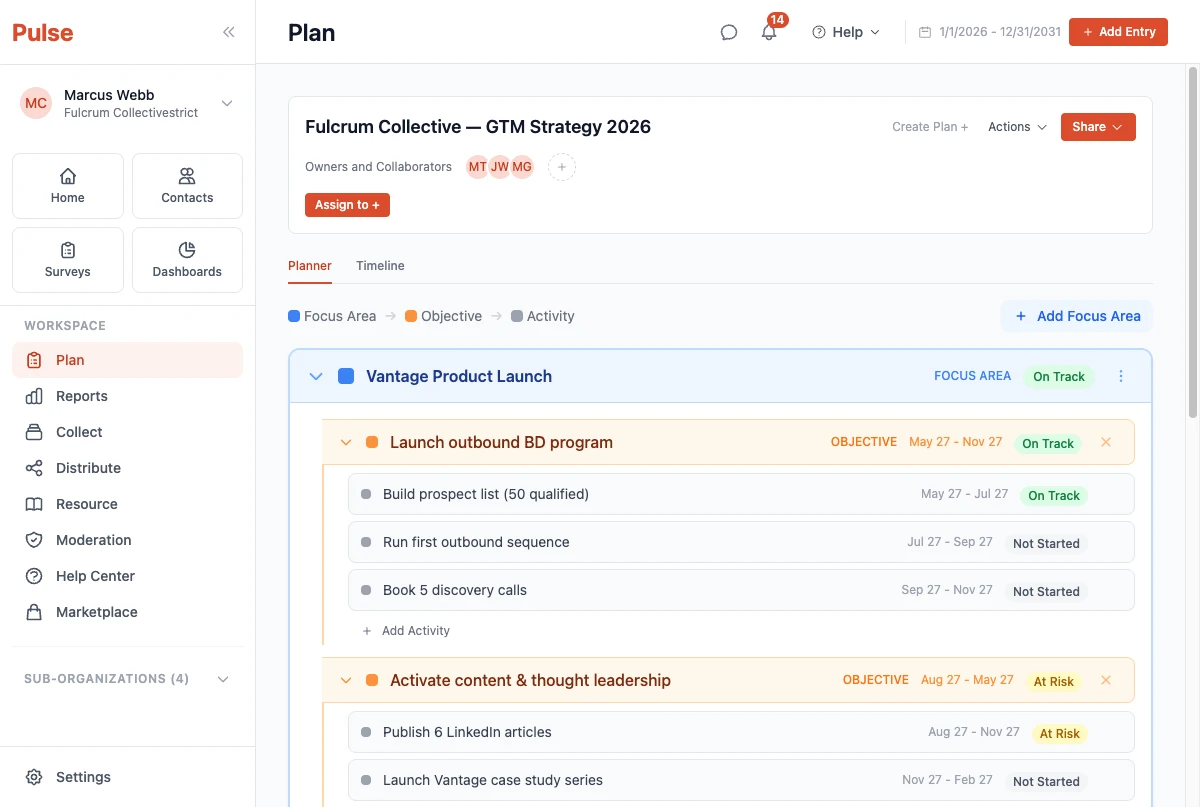
The output is a report leadership can act on in a 30-minute review: which initiatives have team alignment, which are running on assumption, and where the strategy stopped translating into daily work. Then Pulse goes further: when a gap is found, it surfaces the right resource directly to the team member who needs it, without requiring a meeting to figure out what to send.
The result is the feedback loop most organizations are missing between one planning cycle and the next. You can see whether your interventions worked. You have an alignment record that survives leadership transitions. Your next offsite starts from evidence rather than assumption.
Alignment Intelligence report · Pulse
All alignment intelligence resources
Everything published on alignment intelligence, organized by topic.
Foundational
- What Is Alignment Intelligence? The Measurement Category Between Engagement and Execution
- The Alignment Gap: Why Strategy Fails Between What You Decided and What Your Team Understood
- Employee Engagement vs. Strategic Alignment: Why You Need Both and Why They Are Not the Same
- Organizational Alignment Software: What It Actually Does and What to Look for in 2026
- How to Measure Whether Your Team Actually Understands the Strategy
For Business Teams
- Alignment Intelligence for Business Teams: A Chief of Staff Guide
- The MIT Sloan Study Every Strategy Leader Should Read Before Their Next Offsite
- What Chiefs of Staff Actually Need to Know About the Strategy Execution Gap
- New COO or Chief of Staff: How to Find Out Where Your Team Actually Stands
- What COOs Need to Know About the Alignment Gap Between Planning Cycles
- Your OKR System Tracks What Got Done. It Does Not Tell You Why the Strategy Is Not Moving.
Understanding Why Strategy Stalls
- Seven Signs Your Team Is Not Aligned With the Strategy (Even When They Say They Are)
- My Engagement Scores Look Fine. Why Does It Still Feel Like Something Is Off?
- Communicated the Strategy Constantly. Why Does the Team Still Not Seem to Get It?
- What Is the Difference Between Your Team Executing the Plan and Believing in It?
- Getting Honest Team Feedback About Strategy When Everyone Tells You What You Want to Hear
- After a Failed Initiative: Understanding the Alignment Gap
How Pulse Works
Frequently Asked Questions
What is alignment intelligence?
Alignment intelligence is the direct measurement of whether a team understands the strategic direction, believes it will work, and feels equipped to execute their role within it. It occupies the specific gap between engagement surveys, which measure how people feel about their work, and OKR or execution tracking tools, which measure whether tasks are completed. Alignment intelligence tells you why execution is stalling before it shows up in your output data.
What are the three dimensions of alignment intelligence?
Alignment intelligence is composed of three dimensions: strategic literacy, strategic confidence, and strategic readiness. Strategic literacy measures whether your team can accurately describe the strategy in their own words. Strategic confidence measures whether they believe the approach will work. Strategic readiness measures whether they feel equipped to execute their specific role. Each dimension has a distinct cause and requires a different organizational response. Treating all three as the same problem produces the wrong intervention.
How is alignment intelligence different from an engagement survey?
Engagement surveys measure how people feel about their work, their manager, their sense of purpose, and their workload. Alignment intelligence measures whether they understand the strategic direction and believe it will work. These are different questions that can diverge sharply. A team can score highly on engagement while being completely misaligned with the organization's stated strategic priorities. MIT Sloan research found that roughly half of senior leaders who said they understood the strategy could not accurately describe it when asked directly. Both instruments are valuable and answer different questions.
Can alignment intelligence predict execution failure?
Yes. Alignment intelligence is a leading indicator of execution quality. Low strategic literacy predicts execution drift, where the team moves in a direction that diverges from the intended strategy without realizing it. Low confidence predicts passive compliance and workarounds rather than committed execution. Low readiness predicts stalled initiatives and missed milestones. Harvard Business School attributes 67% of strategic failures to poor execution rather than poor strategy. Measuring alignment upstream gives organizations the ability to intervene before failure shows up in output data.
Who should own alignment intelligence in an organization?
In business, alignment intelligence is typically owned by the COO, Chief of Staff, or VP of Strategy, whoever is responsible for connecting the planning cycle to execution. In nonprofits, the Executive Director or their designee. In schools, the Principal or Head of School. The common thread is a leader whose job requires transmitting strategic direction through other people and then verifying that it was understood, believed, and acted on. Alignment intelligence is the instrument that closes the verification gap these leaders otherwise manage around through gut feel and lagging data.
Is alignment intelligence the same as organizational alignment?
Organizational alignment is the outcome: the state in which a team's understanding, beliefs, and actions are oriented toward the same strategic direction. Alignment intelligence is the measurement practice that tells you how close to that state you actually are. You can have alignment as a goal without having alignment intelligence as an instrument to measure it, which is the situation most organizations are in. The gap shows up in planning cycles that produce the same diagnosis year after year.
The measurement layer your planning cycle is missing.
Pulse gives you a monthly read on strategic literacy, confidence, and readiness across your team, by initiative. See where alignment is holding and where it is not, before execution breaks.
Book a Meeting